AI is reshaping industrial software, but the winners will not be new entrants. Europe's established vendors – already embedded in critical infrastructure, sitting on proprietary data, and trusted by large manufacturers – hold a structural advantage. The question is whether they move fast enough to capture it.
Europe's industrial software companies have an opportunity to reap the AI tailwind
In industrial software, the companies that will capture the AI opportunity are not the ones being built today. They are more likely to be the ones already embedded in the infrastructure of European manufacturing.
“At GRO, we have spent more than a decade investing in advanced B2B software companies operating at the heart of these industries. The rapid development of AI is reshaping this market and with it, how the companies operating in it are valued and understood. What we see is an opportunity that stems from disruption.”
— Lars Lunde, Partner, GRO
The case for industrial AI – Europe's moment
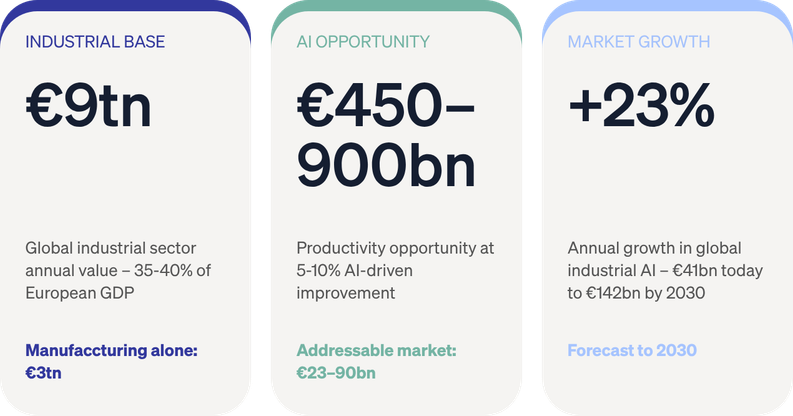
The global industrial sector generates approximately €9 trillion in annual value, equivalent to 35 to 40% of European GDP, where manufacturing alone accounts for €3 trillion.¹ These are not fast-moving consumer markets. They are large, complex, and historically underserved when it comes to software and automation.
AI is beginning to change that. Productivity improvements across industrial sectors could translate into a productivity opportunity measured in the hundreds of billions of euros – and even a modest share of that value captured by software providers represents a significant addressable market.¹ The global industrial AI market is already growing at 23% annually and is forecast to reach €142 billion by 2030, up from €41 billion in 2024.²
The next wave of AI will be won where intelligence meets matter: in robotics, manufacturing, energy systems, and industrial operations.³ That is precisely where Europe has spent decades building its strengths. While the US and China have a clear headstart in foundational model development, Europe holds more than half the global market for automation solutions needed for industrial AI deployment, and significant market shares in robotics and industrial software.⁴ The manufacturing ecosystem is 33% more advanced than the US.⁵ The industrial automation install base is 40% larger for industrial AI.⁶ Europe's strengths in the physical and industrial dimensions are underappreciated and the software companies serving European industry are well positioned.
Why accuracy matters – the limits of generative AI in industrial settings
To understand why established industrial software vendors are strengthened rather than threatened by AI, it is necessary to understand a constraint that most commentary on AI overlooks.
Generative AI models are probabilistic. Given the same input, they may produce different outputs. For most applications – writing, summarizing, coding assistance, customer support – this is entirely acceptable. The cost of an imperfect answer is low, and the efficiency gains are substantial.
In industrial software, the equation is entirely different. Klaus Andersen, CEO of Tacton – a GRO portfolio company and leading provider of CPQ software for complex industrial manufacturers – describes the stakes plainly. Tacton is the system of record for a critical part of its customers' sales process. The configuration logic it runs produces financially binding documents, with extremely tight requirements around data integrity and audit trail. The output must be correct, and it must be the same every time.
That is precisely why generative AI cannot simply replace the core of what these businesses do.
"Generative AI models are non-deterministic. The output may vary even when the input is identical, and you cannot guarantee it is correct. In our world, a configuration must produce the same right answer every single time. That is simply not something generative AI can do today."
— Klaus Andersen, CEO, Tacton
This defines where AI adds value in an industrial context and where it does not. The deterministic core – the system of record, the configuration engine, the audit trail – remains protected. Everything around it becomes faster, smarter, and more capable. Generative AI enhances the system. It does not replace it. For investors, this distinction matters: the moat around the best industrial software companies is not eroded by the arrival of powerful foundation models. It is reinforced.
Incumbent advantage and distribution – why established vendors capture the value
The common assumption holds that AI favors the newcomer. In many software categories, that may hold true. In industrial enterprise software, the structural barriers to entry are not primarily technical – they are relational, operational, and data-driven, and they compound over time in ways that no foundation model can shortcut.
“The shift itself is not surprising to us. What has changed is the speed and volatility with which it has played out in public markets. Our strategy remains focused on advanced B2B enterprise software companies with deep product capabilities, strong domain expertise, and solutions embedded in customers' operational workflows."
— Lars Lunde, Partner, GRO
The incumbency advantage operates on three levels. The first is data. An established vendor serving large industrial manufacturers has accumulated years of configuration data, usage patterns, and domain-specific knowledge that a new entrant simply cannot replicate. That data is what makes AI genuinely useful in practice – not just impressive in a demo.
The second is trust and integration depth. Industrial software is deeply embedded in critical processes. Switching costs are high. Procurement teams at large manufacturers do not change vendors without extensive evidence references, compliance documentation, and implementation support at a scale that early-stage companies cannot provide. As Klaus Andersen puts it: "Our customers want their core business processes running on proper commercial enterprise software. It needs to be maintained, secure, and operational around the clock. You cannot build that on two people and a weekend project – this is critical infrastructure."
The third is distribution. For Tacton and companies like it, AI capabilities deploy directly into an existing installed base – into customer relationships that already exist, at a scale that cannot be replicated overnight. A new entrant must build the product and win the customer simultaneously. An incumbent deploys new capabilities into relationships built over decades.
Large manufacturing customers are reinforcing this dynamic from the demand side. They are no longer asking their software vendors whether they have an AI strategy – they are making it a procurement requirement. Vendors who cannot demonstrate a credible AI roadmap are finding that renewals once treated as automatic are now being contested. This pressure benefits the incumbents who can respond quickly, because they already have the product, the data, and the customer relationship to do so.
The response – capturing the AI opportunity – requires more than embedding stand-alone capabilities. It requires incumbents to accelerate their entire product roadmap, delivering more value to customers, faster than before and even more closely aligned with their core business needs. Accelerating product delivery requires incumbents to transform their operations through new ways of working across every function: more efficient AI-first R&D processes, scalable and automated GTM motions, and autonomous customer success and support. All while embedding AI capabilities at the core of the product itself. Only those who move quickly will capture the value and stave off the AI native entrants.
A moment of clarity, not uncertainty
The question running through most investor conversations today is whether AI changes the fundamental value of software incumbents. The pace of development is real, the new entrants are serious, and the uncertainty in public markets has been significant.
But looking across the industrial software landscape – at the depth of integration, the proprietary data, the trust built over decades, and the structural reality that deterministic processes cannot simply be replaced by probabilistic models – the picture that emerges is one of durability, not disruption. The companies best placed to capture the AI opportunity in European industry are not the ones being built today. They are the ones already embedded in the infrastructure of European manufacturing.
GRO has been investing behind this conviction for more than a decade. What AI has changed is not the direction, but the pace.
¹GRO Research; Eurostat ²IoT Analytics, Industrial AI Market Report 2025–2030 ³Francois Candelon (BCG Henderson Institute) and Theos Evgeniou (INSEAD), Fortune, 13 March 2026 ⁴Accenture, Julie Sweet, 2025 ⁵OECD / World Bank industrial output data ⁶International Federation of Robotics
GRO Insights
We are dedicated to uncovering the full potential of software, and we believe that it can only be achieved through collaboration. Together, we unleash the power of software.